To measure flour by volume, fluff it in the bag, spoon it into a dry measuring cup until it overflows, then sweep off the excess with a straight edge. Don't scoop or tap the cup. Measured this way, a cup of all-purpose flour weighs about 120 grams, and weighing it on a scale is the most accurate method.
Key facts
- King Arthur Baking weighs 1 cup of spooned and leveled all-purpose flour at 120 g (4 1/4 oz).
- Scooping the cup straight into the bag packs the flour; King Arthur says a compacted cup can hold up to 160 g.
- "1 cup sifted flour" means sift first, then measure. "1 cup flour, sifted" means measure first, then sift.
- Brown sugar is the exception: pack it firmly so it holds the cup's shape when turned out.
- 1 US cup = 16 tablespoons = 236.6 mL (NIST).
What is the right way to measure flour?
Use the spoon-and-level method. King Arthur Baking and several university extension services describe the same three steps:
- Fluff. Stir the flour in its bag or canister with a spoon to loosen it. Flour settles during shipping and storage.
- Spoon. Spoon flour lightly into a dry measuring cup until it mounds above the rim. Don't shake, tap or press the cup, which packs the flour back down.
- Level. Sweep the back of a knife, a metal spatula or a bench knife across the rim so the flour is flush with the top.
North Dakota State University Extension sums it up as "pile, then level." Mississippi State University Extension suggests holding the cup over the flour container or the sink while you spoon, so the overflow is easy to clean up.
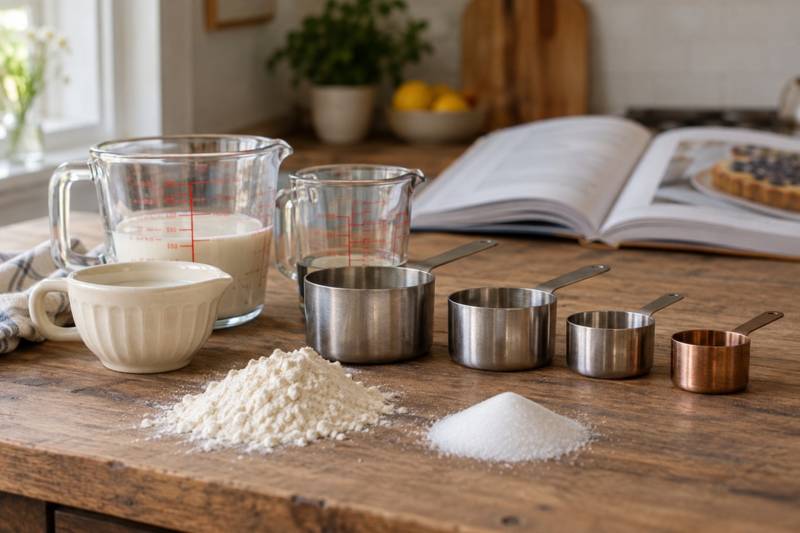
Use a nested dry measuring cup in the exact size the recipe calls for (1/4, 1/3, 1/2 or 1 cup), not a glass liquid measure. You can't level flour in a cup with a spout and headroom above the line. See dry vs. liquid measuring cups for why.
Why does scooping flour add weight?
When you drag the measuring cup through the bag, the rim pushes flour into the cup and compresses it. You end up with more flour in the same space. Health Canada's food guide makes the same point: a cup scooped from the bag is packed and holds more flour than the recipe needs.
How much more depends on the flour and how hard you press, which is exactly the problem. King Arthur weighs a spooned cup of all-purpose flour at about 120 g and says a compacted cup can hold up to 160 g. That's up to a third more flour than the recipe writer intended.
Extra flour shows up in the finished food. NDSU Extension notes that packing too much flour into the cup can make baked goods dry. Cookies spread less, cakes turn dense and doughs feel stiff.
How much does a cup of flour weigh?
Cups & Temps uses King Arthur Baking's figures for flour, because King Arthur weighs flour the way most US home recipes assume it's measured: spooned and leveled.
| Flour | 1 cup (spooned and leveled) | Source |
|---|---|---|
| All-purpose flour | 120 g | King Arthur |
| Bread flour | 120 g | King Arthur |
| Cake flour | 120 g | King Arthur (its unbleached cake flour) |
| Whole wheat flour | 113 g | King Arthur |
| Almond flour | 96 g | King Arthur |
You'll see other numbers elsewhere. USDA's FoodData Central lists all-purpose flour at 125 g per cup and bread flour at 137 g, and it describes its cake flour cup as unsifted and dipped. The gap comes mostly from how the cup was filled, not from the flour. For more ingredients, see the cups to grams hub.
How do you measure flour with a scale?
A kitchen scale takes the technique out of it. King Arthur recommends weighing whenever you can, because you get the same 120 g of all-purpose flour every time no matter how settled the bag is.
- Set a bowl on the scale and press the tare (zero) button.
- Spoon or pour flour into the bowl until the display reads the weight you need.
- Tare again before adding the next ingredient, so you can weigh everything into one bowl.
If a recipe gives only cups, multiply by 120 for all-purpose flour: 2 1/2 cups becomes 300 g. If a recipe gives both cups and grams, trust the grams. A scale also helps with small amounts: a tablespoon of all-purpose flour is about 7.5 g (1/16 of a 120 g cup). For other weight conversions, see grams in a cup and grams in an ounce (1 oz = 28.35 g).
What's the difference between "1 cup sifted flour" and "1 cup flour, sifted"?
The word order tells you when to sift.
- "1 cup sifted flour": sift the flour first, then spoon the sifted flour into the cup and level it.
- "1 cup flour, sifted": measure 1 cup of flour first, then sift it.
The two don't give you the same amount. Sifting adds air, so a cup filled with already-sifted flour holds less. America's Test Kitchen puts the difference at roughly 20 to 30 percent by weight. That matters most in delicate cakes such as angel food or genoise, where the recipe writer chose the wording on purpose.
Do you still need to sift flour?
Usually not for lump removal. Extension guides from NDSU and the University of Wisconsin note that most flour sold today is presifted at the mill. King Arthur still sifts when flour has sat in the pantry long enough to compact, or when flour needs to fold gently into whipped egg whites. If a recipe calls for sifted flour and gives a weight, weigh it and sift afterward; the weight doesn't change.
How do you measure brown sugar?
Brown sugar is the one common dry ingredient you pack on purpose. Spoon it into a dry measuring cup and press it down firmly with the back of a spoon, adding more until it's level with the rim. Kansas State and Wisconsin extension guides use the same test: turned out of the cup, packed brown sugar should hold the cup's shape.
Unless a recipe says otherwise, US recipes mean packed. The difference is large. USDA lists a cup of packed brown sugar at 220 g and an unpacked cup at 145 g. If a recipe says "lightly packed," Mississippi State Extension suggests pressing gently rather than until every air pocket is gone. See brown sugar cups to grams for the full conversion.
How do you measure other dry ingredients?
| Ingredient | How to measure by volume |
|---|---|
| Granulated sugar | Dip or spoon into the cup and level. It flows freely, so method barely changes the weight (USDA: 200 g per cup). |
| Powdered sugar | Spoon and level, like flour. It compresses easily; USDA lists 120 g unsifted and 100 g sifted per cup. |
| Baking powder, baking soda, salt, spices | Dip a measuring spoon into the container and level it with a straight edge. Use spoons for anything under 1/4 cup. |
| Shortening, peanut butter, softened butter | Press into a dry cup with a spatula to remove air pockets, then level. |
| Chopped nuts, raisins, chips | Spoon into a dry cup and level loosely; don't press. |
For spoon-to-cup math, 1 cup = 16 tablespoons and 1 tablespoon = 3 teaspoons. See tablespoons in a cup and teaspoons in a tablespoon. For butter, the wrapper markings are easier: one stick is 8 tablespoons, or 1/2 cup (tablespoons in a stick of butter).
Questions people ask
Should I scoop or spoon flour into a measuring cup?
Spoon it. Scooping packs the flour, and King Arthur says a compacted cup of all-purpose flour can reach 160 g instead of about 120 g.
How many grams are in a cup of all-purpose flour?
About 120 g when spooned and leveled, according to King Arthur Baking. Other sources list more because they weigh a dipped cup.
Can I use a glass liquid measuring cup for flour?
It's not a good idea. You can't level flour at the 1-cup line in a cup with extra headroom, so the amount varies; use a nested dry cup or a scale.
Do I sift before or after measuring?
Follow the wording: "sifted flour" means sift, then measure; "flour, sifted" means measure, then sift. If the recipe gives grams, weigh first and sift afterward.
Does brown sugar need to be packed?
Yes, unless the recipe says otherwise. Press it in until it holds the cup's shape when turned out; a packed cup weighs about 220 g.
Sources
- King Arthur Baking: How to measure flour the right way
- King Arthur Baking: Ingredient weight chart
- King Arthur Baking: Why sift flour?
- NDSU Extension: Kitchen Equipment and Recipes (FN1812)
- K-State Research and Extension: Cooking Basics: Measuring Tools and How to Use Them (MF3518)
- Mississippi State University Extension: Measuring dry or solid ingredients
- University of Wisconsin–Madison Extension, Clark County: Helpful tips for measuring ingredients
- Health Canada: Measure ingredients like a pro
- America's Test Kitchen: The right time to sift
- USDA FoodData Central: Sugars, brown (FDC 168833)
- NIST: SP 811 Appendix B.9, conversion factors