Your refrigerator temperature should be 40°F (4°C) or below, and your freezer should be at 0°F (-18°C). Those are the FDA and USDA limits. Because the dial on most fridges isn't a thermometer, aim the air a little below 40°F and check it with an appliance thermometer rather than trusting the setting.
Key facts
- Fridge: 40°F (4°C) or colder. Freezer: 0°F (-18°C).
- Ohio State University Extension suggests setting the fridge air between 37°F and 39°F so the food itself stays just under 40°F.
- Food kept frozen at 0°F stays safe indefinitely; freezer storage times are about quality.
- Check with an appliance thermometer: USDA says to read it after 5 to 8 hours.
- In a power outage, a closed fridge keeps food cold about 4 hours; a full freezer about 48 hours, a half-full one about 24.
What temperature should a fridge be?
The one number that matters for safety is 40°F. The FDA tells consumers to keep the refrigerator at or below 40°F (4°C), and FoodSafety.gov and USDA's Food Safety and Inspection Service (FSIS) give the same limit. Above 40°F you're in the "danger zone" (40–140°F), where bacteria multiply fastest.
So what is the ideal fridge temperature in practice? Air temperature swings every time you open the door, and food warms the air when you load groceries. That's why Ohio State University Extension recommends setting the fridge air between 37°F and 39°F: it keeps the food just below 40°F with a small buffer. A US Department of Energy guide (written by Pacific Northwest National Laboratory) gives a wider normal fridge range of 35°F to 40°F.
Colder isn't automatically better. Water freezes at 32°F, so a fridge set near freezing can turn lettuce, milk and eggs icy. If food at the back is freezing, nudge the setting up a notch and recheck.
Why 40°F, not just "cold"
Refrigeration slows bacteria; it doesn't stop all of them. The FDA points out that Listeria can grow even at refrigerator temperatures, which is one reason to keep the fridge reliably cold, wipe up spills and follow storage times. Our food storage charts list how many days common foods keep at 40°F or below.
What temperature should a freezer be set at?
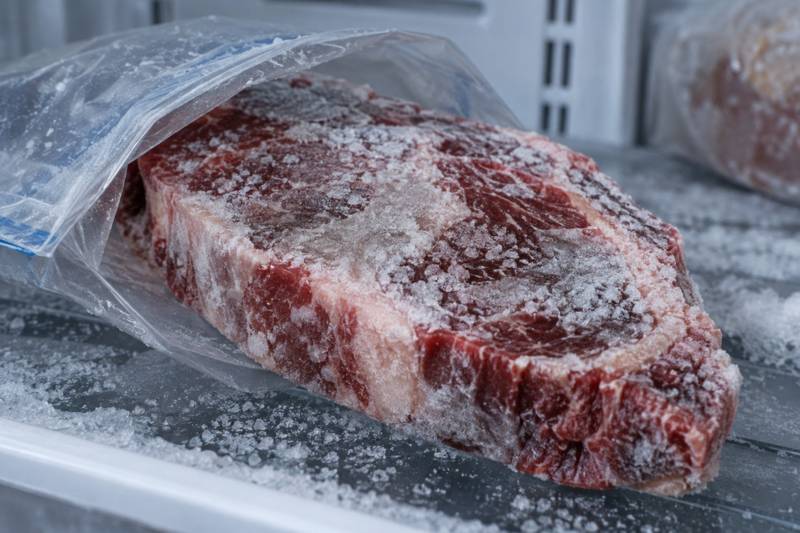
The ideal freezer temperature is 0°F (-18°C). FDA, FSIS and FoodSafety.gov all use that number. FSIS says food kept frozen at 0°F stays safe indefinitely. The times you see on freezer charts (for example, 3–4 months for leftovers) are for best flavor and texture, not safety.
The safety line is 0°F or below, so a freezer that reads a few degrees colder is fine. If your packages are frosting over, see how to prevent freezer burn.
| Appliance | Target | In Celsius | Source |
|---|---|---|---|
| Refrigerator (limit) | 40°F or below | 4°C or below | FDA, FSIS, FoodSafety.gov |
| Refrigerator (suggested air setting) | 37–39°F | about 3–4°C | Ohio State University Extension |
| Freezer | 0°F or below | -18°C or below | FDA, FSIS, FoodSafety.gov |
| Danger zone | 40–140°F | 4–60°C | FSIS |
Need a different reading converted? Use the temperature converter.
How to check your refrigerator temperature
The numbers on a fridge dial (1–5, "colder/warmer") aren't degrees, and some digital displays read the air near the sensor rather than where your food sits. The FDA recommends a freestanding appliance thermometer for the fridge and another for the freezer, checked often. USDA's appliance thermometer guidance works like this:
- Fridge: put the thermometer in a glass of water and set it in the middle of the refrigerator. The water reads closer to food temperature than the air does.
- Freezer: tuck the thermometer between frozen packages.
- Wait 5 to 8 hours, keeping the doors closed as much as you can, then read it.
- Adjust if needed. If the fridge is above 40°F or the freezer above 0°F, turn the control colder, wait another 5 to 8 hours and check again.
Leave the thermometers in place afterward. They cost little, and during a power outage they're the only way to know whether food stayed cold. An appliance thermometer is different from the probe you use on a steak; for that, see how to use a meat thermometer.
Fridge zones: where food should go
Temperature isn't the same everywhere inside a refrigerator. A few rules from official and extension sources:
- Door: the warmest spot. The FDA and FoodSafety.gov say to keep eggs in their carton in the main compartment, not the door.
- Upper shelves: ready-to-eat foods that won't be heated again before you eat them (Ohio State University Extension).
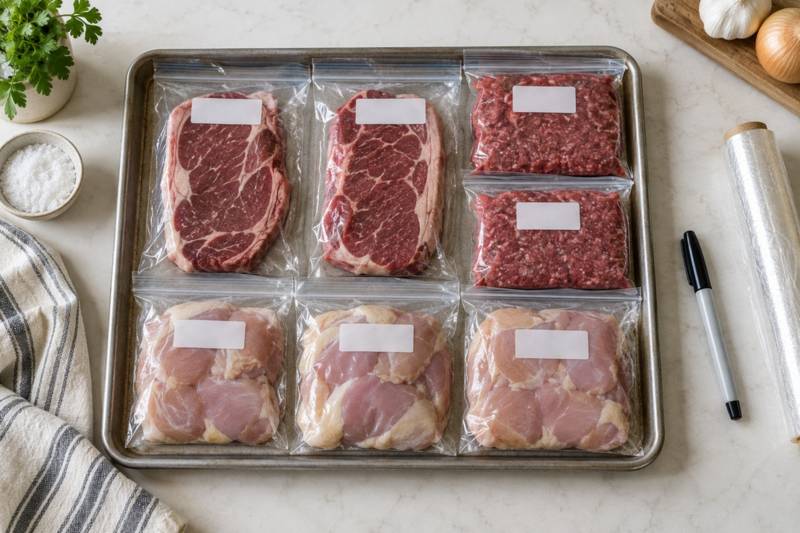
- Bottom shelf: raw meat, poultry and seafood, wrapped and set in a container or on a tray so juices can't drip onto other food. FoodSafety.gov also says to keep raw meat in sealed, leakproof bags or containers and to freeze it if you won't use it within a few days.
Raw chicken and ground beef only keep 1–2 days in the fridge, so check the dates on our pages for raw chicken, ground beef and eggs.
What to do after a power outage
Keep the doors shut. The FDA says an unopened refrigerator keeps food cold for about 4 hours, and a full freezer holds its temperature for about 48 hours. The CDC gives the same 4 and 48 hours and adds that a half-full freezer keeps food safe for about 24 hours.
When the power comes back:
- Read your appliance thermometers first. According to the FDA, food is generally safe if the fridge is still at 40°F or below, or if food was above 40°F for 2 hours or less.
- Refrigerated perishables: after 4 hours without power, the CDC says to throw out meat, fish, eggs, milk and leftovers. Toss anything with an unusual color, smell or texture.
- Frozen food: if the freezer thermometer reads 40°F or below, the FDA says the food is safe and can be refrozen. Quality may drop.
- Not sure? If you don't know how long food sat above 40°F, throw it out. Never taste it to decide.
For more on safe timing, read how long food can sit out and can you refreeze thawed meat.
Questions people ask
What should the fridge temperature be set at?
Set it so the inside stays at 40°F or below. Ohio State University Extension suggests an air temperature of 37 to 39°F, confirmed with an appliance thermometer rather than the dial.
What is the normal temperature inside a fridge?
A properly working fridge runs at or below 40°F. A US Department of Energy guide puts the normal range at 35 to 40°F.
What is the best freezer temperature?
0°F (-18°C). At that temperature food stays safe indefinitely; storage times only describe quality.
Why is my fridge freezing food?
The setting is likely too cold. Water freezes at 32°F, so raise the setting a notch and recheck with a thermometer after 5 to 8 hours.
Is 42°F too warm for a refrigerator?
Yes. Anything above 40°F is in the danger zone, where bacteria multiply fastest. Turn the control colder and check again after several hours.
Sources
- FDA: Are you storing food safely?
- FDA: Refrigerator thermometers: cold facts about food safety
- USDA FSIS: Appliance thermometers
- FoodSafety.gov: 4 steps to food safety
- CDC: Discarding food after a power outage
- Ohio State University Extension: Refrigerator storage, what goes where
- US DOE Building America Solution Center (PNNL): Check refrigerator temperature