Carryover cooking is the rise in internal temperature after meat leaves the heat. ThermoWorks puts it at 3–4°F or more for steaks and chicken pieces and up to 10–15°F for big roasts and turkeys. Rest whole cuts of beef, pork, lamb and veal at least 3 minutes at 145°F, per USDA; chicken needs no USDA rest.
Key facts
- USDA: whole cuts of beef, pork, veal and lamb are safe at 145°F followed by a rest of at least 3 minutes.
- ThermoWorks: small steaks, chicken pieces and burgers rise at least 3–4°F while resting; large roasts and turkeys can rise 10–15°F.
- Certified Angus Beef pulls steaks about 5°F before the target doneness and roasts 5–10°F early.
- America's Test Kitchen rests steaks, chops and chicken parts about 5 minutes and a whole roast chicken about 20 minutes.
- Poultry and ground meat have no USDA rest requirement, but they must reach 165°F and 160°F.
What is carryover cooking?
When meat cooks, the outside gets much hotter than the center. Take it off the grill or out of the oven and that heat keeps moving inward, so the thermometer in the middle keeps climbing for a few minutes. That climb is carryover cooking.
The rise is real enough to change doneness. A steak pulled at exactly your target will usually finish a few degrees past it. That's why cooks pull meat early and let the rest finish the job, and why a meat thermometer matters more than a timer.
How much does steak temperature rise when resting?
For a typical steak, plan on a few degrees. ThermoWorks says small steaks, individually cooked chicken pieces and burgers rise at least 3–4°F during resting. Certified Angus Beef advises taking steaks off the heat when the thermometer reads about 5°F below the doneness you want.
Bigger cuts carry over more. ThermoWorks says large roasts and turkeys can rise as much as 10–15°F, and Certified Angus Beef pulls roasts 5–10°F early.
| Cut | Typical rise while resting | When cooks pull it |
|---|---|---|
| Steaks | At least 3–4°F (ThermoWorks) | About 5°F below target (Certified Angus Beef) |
| Pork chops | A few degrees | About 5°F early (ThermoWorks) |
| Beef roasts and prime rib | Up to 10–15°F (ThermoWorks) | 5–10°F early (Certified Angus Beef) |
| Pork roasts | Up to 10–15°F (ThermoWorks) | 10–12°F early (ThermoWorks) |
| Whole chicken or turkey | Up to 10–15°F (ThermoWorks) | ThermoWorks: 10–12°F below target; confirm 165°F after the rest |
What makes carryover bigger or smaller
- Size. The more mass, the more stored heat and the bigger the rise at the core.
- Cooking heat. Meat cooked at a high temperature has a hotter outer layer, so more heat moves inward. America's Test Kitchen notes that a chicken roasted at 400°F carries over longer than one roasted at 350°F.
- Where it rests. ThermoWorks says a cold plate, an uncovered cut or moving meat out of its hot pan lets heat escape and shrinks the rise. A low oven or heat lamp makes it bigger.
- Covering. A loose foil tent holds in some heat while letting steam escape, so a crust doesn't go soggy.
Why USDA calls for a 3-minute rest
USDA's safe minimum for whole cuts of beef, pork, lamb and veal is 145°F with at least 3 minutes of rest before you carve or eat. FoodSafety.gov says the rest lets the innermost parts and juices finish cooking safely. Cornell Cooperative Extension explains that during the rest the temperature holds steady or keeps rising, which continues to destroy harmful germs.
The rest is part of the safety standard, not just a chef's habit. If you cut a pork chop the moment it hits 145°F, you skip the time USDA counts on. Steaks and chops are the cuts where cooks most often want to eat right away, so build the 3 minutes into your plan.
Which foods don't need a USDA rest?
USDA lists no rest time for ground meat (160°F), poultry (165°F), fish (145°F) or leftovers (165°F). Once they hit the number, they're safe. Resting them is still good for juiciness; it just isn't a safety requirement.
When to pull meat off the heat
Pulling early only works if the meat still reaches the safe minimum after resting. For beef, pork, lamb and veal, that means the temperature after the rest should be at least 145°F if you're following USDA guidance. Medium (about 145°F, per Certified Angus Beef) meets it; medium rare (about 135°F) and rare (about 125°F) are what many cooks choose, but they fall below the USDA minimum. Our steak temperature chart and prime rib page list each doneness level.
For poultry, USDA's standard is 165°F in every spot. ThermoWorks suggests pulling whole birds 10–12°F early, and America's Test Kitchen takes roast chicken breast out at 160°F and lets carryover finish it. If you pull early, check the thickest part of the breast and the innermost thigh and wing again after resting and make sure each reads 165°F. If it doesn't, put the bird back in the oven. People who are pregnant, older, very young or have weakened immune systems should stick to the USDA numbers.
How long should meat rest?
USDA sets the safety minimum; cooking authorities add time for juiciness. The table pulls their numbers together.
| Food | Rest time | Source |
|---|---|---|
| Whole cuts of beef, pork, lamb, veal | At least 3 minutes (safety minimum) | USDA |
| Steaks, chops, chicken parts | About 5 minutes | America's Test Kitchen |
| Pork roast | 10–20 minutes, loosely tented | America's Test Kitchen |
| Whole roast chicken | About 20 minutes, untented | America's Test Kitchen |
| Medium-rare beef roast | About 30 minutes, loosely tented | America's Test Kitchen |
| Whole turkey | 20 minutes before carving | USDA FSIS |
| Large turkey | 30–40 minutes, untented | America's Test Kitchen |
How long to rest steak
At least 3 minutes to meet USDA guidance, and about 5 minutes for a thinner steak, per America's Test Kitchen. Its separate guide on resting gives 5–10 minutes for a thin steak or chop.
How long should chicken rest?
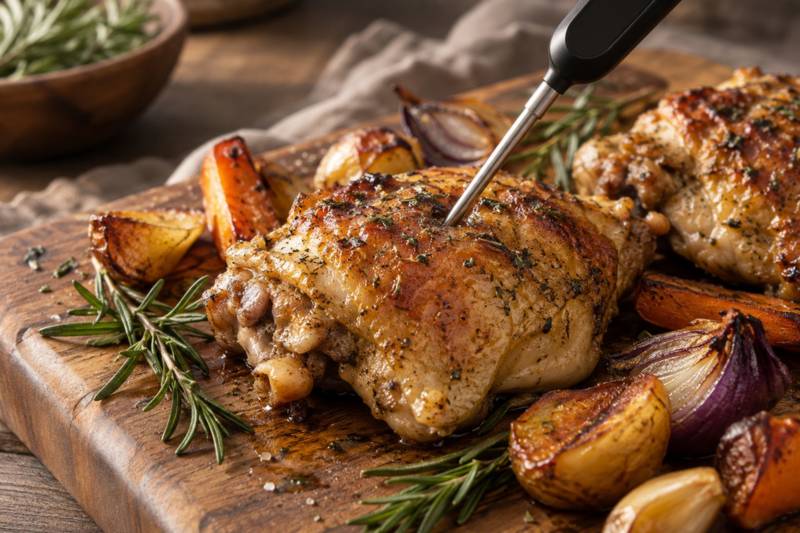
Chicken pieces need about 5 minutes and a whole roast chicken about 20, according to America's Test Kitchen. In its test, a chicken left untented for 20 minutes was still above 140°F, so a rest won't leave it cold. USDA has no rest requirement for chicken, so you can serve it as soon as every part reads 165°F. See our whole chicken temperature page.
How long to rest a roast or turkey
Large roasts hold heat well. America's Test Kitchen rests a medium-rare beef roast about 30 minutes and a large turkey 30–40 minutes. USDA FSIS advises letting a turkey stand 20 minutes before carving so the juices set.
Does resting really keep meat juicier?
Yes, and America's Test Kitchen measured it. It cooked pork loins to 140°F and sliced them after different rests. Slicing right away lost about 10 tablespoons of juice; a 10-minute rest cut that to about 4 tablespoons, and a 30-minute rest to about 1 tablespoon. ThermoWorks explains that the muscle fibers tighten as they cook and relax as they rest, holding on to more liquid.
Don't stretch a rest into hours on the counter. Bacteria grow fastest between 40°F and 140°F, and cooked food shouldn't sit out more than 2 hours (1 hour above 90°F). Our guide to how long food can sit out has the details, and leftovers keep 3–4 days in the fridge (see leftovers storage).
Questions people ask
How many degrees does a steak rise when resting?
ThermoWorks says small steaks rise at least 3–4°F. Certified Angus Beef suggests pulling steaks about 5°F below your target doneness.
How long should chicken rest after cooking?
America's Test Kitchen rests chicken parts about 5 minutes and a whole roast chicken about 20 minutes. USDA has no rest requirement for poultry as long as it reaches 165°F.
Does resting meat make it safer?
For whole cuts of beef, pork, lamb and veal, yes: USDA's 145°F standard includes a rest of at least 3 minutes, during which the temperature holds or rises and keeps killing germs.
Should you cover meat while it rests?
A loose foil tent keeps in some heat without steaming the crust, ThermoWorks says. America's Test Kitchen rests roast chicken and turkey uncovered to protect crisp skin.
Can I pull chicken at 160°F and let it carry over?
Some cooks do, but USDA's guidance is that chicken reach 165°F. If you pull early, recheck after resting and return it to the heat if any spot reads below 165°F.
Sources
- USDA FSIS: Safe Minimum Internal Temperature Chart
- FoodSafety.gov: Cook to a Safe Minimum Internal Temperature
- Cornell Cooperative Extension: Safe Minimum Cooking Temperatures
- USDA: Brining Safely Will Bring Tender, Flavorful Meat to the Thanksgiving Table
- ThermoWorks: Resting: The Final Phase of Cooking
- Certified Angus Beef: Degree of Doneness
- America's Test Kitchen: Why You Shouldn't Skip Resting Meat
- America's Test Kitchen: Resting Meat
- America's Test Kitchen: Resting Meat Is Worth It, and We've Got the Data to Prove It
- America's Test Kitchen: Seven Steps to Perfect Roast Chicken